
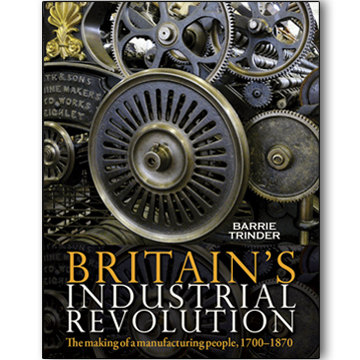
Description
The Industrial Revolution changed the world. The images we all share – of steam engines and locomotives, of smoke and smog, and of regiments of working men and women flooding out of factory gates at the end of their shifts – are so familiar that it is easy to forget just how momentous, profound and upsetting these innovations were at the time. This bold industrial age brought untold wealth and prosperity, but it could also be traumatic, dirty, dangerous and cruel.
The Industrial Revolution occurred first, and most dramatically, in Great Britain. The earliest true factories were built here, along with steam engines, iron ships and railways. New iron-making technologies were developed here. Mines were sunk to new depths. Inventive and entrepreneurial minds sought to mechanise production, to make things better, faster and more profitably. Britons became a manufacturing people.
New ways of living emerged. A flood of rural humanity poured into industrialising towns in search of work. Patterns of life became tied to those of the machine. Towns sprawled, production boomed, and British manufactured goods dominated world trade.
About the book
This important new book endeavours to explain the true nature of the Industrial Revolution in every part of the British Isles. Prominent, of course, are those districts which witnessed the greatest economic and social change, such as Manchester, Birmingham, the Ironbridge Gorge and Leeds. Yet it also shows how even the sleepiest of sleepy hollows could be affected by industrial development. The Industrial Revolution affected everyone.
This is no dry economic tone. It does not dwell on abstract theories about why the Industrial Revolution occurred in Britain before anywhere else. Instead, it focuses on the reality of what actually happened, where, when and how. Its authenticity comes from describing real people, places and experiences in every part of the country.
About the Author
Barrie Trinder has gained an impressive depth and breadth of knowledge of the Industrial Revolution during a teaching career of more than forty years. For several years he lived in the Black Country, and spent four decades in Shropshire, during which time his research on Coalbrookdale and the Ironbridge Gorge won him international recognition.
He has written about many of the most celebrated sites of the Industrial Revolution period, and has contributed substantially to nomination documents for World Heritage designation for three of them. As an active member of TICCIH (The International Congress for the Conservation of the Industrial Heritage) and as editor of the Blackwell Encyclopedia of Industrial Archaeology, he became acquainted with industrial history in many European countries and in North America. As an urban historian he has studied towns throughout England and Wales.
During the last decade his published works have included studies of the probate inventories of people who lived in the Severn Gorge; the Upper Severn Navigation; the suburbs of Shrewsbury; twentieth-century industrial archaeology; and Victorian market-town lodging-houses. His career included fiffteen years at the Ironbridge Institute and five years at the University of Northampton. He is now a freelance writer and consultant and lives in Olney, Buckinghamshire.
- Author: Barrie Trinder
- Binding: Paperback only (hardback has now sold out)
- ISBN: HB 978-1-85936-175-7, PB 978-1-85936-219-8
- Pages: 688
- Illustrations: Over 600, many in colour
- Date of Publication: 30 March 2013
- Dimensions: 246 × 189 mm


Dr Peter Wakelin –
Britain’s Industrial Revolution is a magisterial achievement. Compendious yet sharply incisive, expert yet wise, academically exact yet visually compelling, and at times almost poetic. … There has been no other book like it, and it will be the standard bearer for a generation.
David Gwyn –
An authoritative, comprehensive and accessible study from the hand of a master.
Kate Tiller –
A valuable, accessible and up-to-date overview achieved through an impressive union of local examples and wide historical insights.
John V. Beckett –
A monumental study of the industrial glory that we have now lost. A compelling account.
Sir Neil Cossons –
Renowned historian Barrie Trinder offers a magisterial and comprehensive view, sweeping in its perspectives yet coloured by a wealth of rich and vivid detail. … This new book brings – as no other – the Industrial Revolution into focus.
Jack Hamner, High Peak Review –
Any book described in such phrases as ‘it changed the world’, ‘it changed our way of living’, ‘this revolution affected everyone’ has to be something very special and author Barrie Trinder’s book is certainly that. Reading this very comprehensive account of the Industrial Revolution enables us to appreciate how this development really did affect our way of life… [and] Barrie Trinder has painted a truly human story.